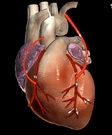
Heart Bypass surgery in India
Heart bypass Surgery (also known as CABG) is a cardiac surgical procedure that improves the blood flow to the heart
What is Heart Bypass surgery?
If you have blocked coronary arteries, a heart bypass surgery can improve the blood flow through these. Your cardiac surgeon will use blood vessel grafts to restore the blood flow to your heart muscles. During the operation, the surgeon will attach these grafts above and below the blocks. It creates a new channel for blood flow. Another name for heart bypass surgery is Coronary Artery Bypass Graft surgery or CABG.
Coronary arteries supply blood to your heart muscles. They originate from the aorta. Due to various reasons, these arteries can narrow down. The deposition of cholesterol plaques inside the arteries is the most common reason. Sometime these plaques will detach from the walls and block the flow of blood. If the blocks are severe, the blood supply will be cut-off to some areas. It results in the death of heart muscles in those areas due to a lack of oxygen. If this happens, you suffer a ‘heart attack’.
Restoring blood supply to that area within a reasonable time can prevent long-lasting damages. Medications may help in dissolving the blocks in some. If the blocks are small, then an angioplasty or a cardiac catheterization may help. But if your blocks are long, severe, or multiple (triple vessel disease), then a bypass surgery is indicated.
A heart bypass surgery team will consist of cardiac surgeons, anesthetists, cardiac nurses, and other operation theatre staff. The duration of the surgery will be around two to three hours. Complete recovery will take about seven to twelve days.
Heart bypass surgery has a success rate of more than ninety-nine percent. Most of those who have surgery will have an incident-free healthy life.
Heart bypass surgery- when to do
You will need heart bypass surgery due to the following reasons
- Severe chest pain with mild exertion or even at rest
- Blocks in more than one coronary artery
- Block in the left main coronary artery
- Non-surgical treatments like cardiac catheterization do not help remove the blockages
A heart bypass surgery will improve the blood flow to the heart muscles. It enables the heart to function in a healthy way.
Heart bypass surgery procedure
You will be in the hospital the night before or on the morning of surgery day.
Since you will have general anesthesia during surgery, you will not have any food the previous night. The hospital staff will take you to the hospital room two hours before the surgery. The surgeon will then have a final look at your health status. If everything is OK, preparations for giving you general anesthesia will start. You will begin to sleep within a few moments of anesthesia and will remain so for the rest of the surgery.
The surgeon will make a long midline incision in your chest. The next step is to divide the breastbone in the middle to reach the chest cavity where your heart lies.
Once the chest is open, the first step will be to harvest the blood vessel conduits. The surgeon usually harvests the internal mammary artery graft from the chest wall. In the meanwhile, the other members of the surgery team harvest blood vessel grafts from either your arm or leg (if needed).
There are two main methods of operation
- on beating heart (off-pump)
- on the arrested heart (on-pump)
In on-pump surgery, the surgeon shifts the blood flow to a heart-lung machine. It is a machine that performs the function of the heart and lungs during the surgery. It allows your surgeon to operate in a still heart.
Once the surgical team prepares the graft, your surgeon will attach it above and below the blockage. The blood will then start flowing through the graft, bypassing the blockage.
In the case of on-pump surgery, the surgeon will shift the blood flow back to your heart from the heart-lung machine. The next step is to start your heart to beat again. When it starts beating, the surgeon will observe the way it works very closely.
There is no need for the heart-lung machine in beating heart operation. Once happy with its function, your surgeon will go ahead and close the chest. The surgical incisions will have either sutures or staples to close it.
Some patients may undergo minimally invasive coronary bypass surgery. In this, the surgeon will make a smaller incision (compared to other modes) in the rib cage. It has advantages of early recovery, less blood loss, and lesser wound healing related complications.
The staff will then move you to the recovery room. You will have breathing assistance if necessary. After an hour or two, you will start waking up.
You will find that there is a bandage over the chest. There will also be some wires that connect your body to some monitors around you. These are to observe the way your body is recovering from surgery.
Recovery from Heart bypass surgery
At hospital
When you recover from the effects of anesthesia, the hospital staff will take you to the ICU. In the ICU, the nurses will keep a close watch on your vital functions. You will go back to your room the next day unless there is a problem.
You will be able to sit up in your bed the day after surgery. Liquid food is preferable in the first two days. After two days, you can have solid food if your appetite is back.
While in the hospital, you will have to walk a few steps now and then. You will also have to do a few coughing exercises to improve your lung function. It will also help to prevent lung infections like pneumonia.
You will go back home from hospital three or four days after surgery.
At home
It is very natural for you to feel exhausted for the first five to six days. Restrict visitors for a few days until you are better.
Wound care at home is critical. You will not have the assistance of experienced nurses as in the hospital. The surgical wound will be a long one and will need time to heal. During healing, it is vital to keep it dry to prevent any infections. While bathing, you need to cover your wound adequately to avoid wetting it.
While leaving the hospital, your surgeon will give you a list of instructions. This list is generally regarding the steps you need to do and to avoid. You will have to follow these instructions so that your recovery is faster.
The recovery timeline will be different for different persons. But generally, you can start going to the office after three weeks of surgery. If your work is strenuous, you will have to wait for another two or three weeks. Driving will have to wait for at least five to six weeks. Doing mild physical exercises after three to four weeks is very good. You can start climbing the stairs. But, keep it to a minimum for a few days.
Lifting heavy objects can affect the healing of your breastbone and the incision wound. So do not lift anything more than 4 to 5 kg for a few weeks.
Though a safe surgery, a heart bypass also has some risks and complications. You need to be aware of the signs and symptoms of these complications.
Risks and complications of heart bypass surgery
The common ones include
- Bleeding
- Infection of the wound
- Problems with wound healing
- Abnormal heart rate and rhythm
All these are treatable and usually do not cause further problems.
Heart bypass – Factors that affect long-term success
Heart bypass surgery has a success rate of more than ninety-eight percent. Almost eighty percent of those having the operation will not have a problem for the next fifteen to twenty years.
There are a few things that can help you to keep your heart in good health. They include
- Avoiding habits like smoking, over-drinking, etc
- Doing regular physical exercises
- Having a heart-friendly diet. Keep the intake of red meat, sugars, salted food, etc. to the minimum. Have more foods like oats, leafy vegetables, lean meat, egg whites, etc.
- Have periodic check-ups to assess the health of your heart.
This way, you can detect any problem and treat it at the earliest.
All these are not difficult to follow, more so what you get in return is a healthy heart.
Side effects of bypass surgery
Heart bypass is a major operation that has some effects on your body and mind. The side effects are natural, and everyone having the surgery will have one or the other. Some of the side effects that you can expect are
- Tiredness
- Difficulty in sleeping
- Tingling or pricking sensation in the area of blood vessel grafts
- Feeling less hungry than before
- Pain in the back
- Muscle pain or cramps
- Feeling emotionally low
- Mood swings
All these side effects are very temporary. You will be back to normal within a few days.
Top Hospitals for Heart Bypass surgery
We partner with India's most respected accredited hospitals.




Frequently Asked Questions
Yes, CABG is a type of open-heart surgery. In an open-heart surgery, the surgeon will reach the heart by opening the chest wall along with the ribs. After surgery, the surgeon will place the ribs in its natural position and secure it with wires. Within a few weeks, the ribs and the chest wall heal completely and the patient will only have a scar in the chest. In a CABG, the surgeon will bypass the coronary artery with blocks with blood vessel grafts
A bypass surgery restores the proper blood supply to the heart muscles with the help of blood vessel grafts. Internal mammary arteries are the most common type of blood vessel grafts. These grafts function properly for twenty years or more without any problems. If the graft is from a vein in the legs, it may develop a few problems after ten years or so. You need to make a few changes in your life to make the grafts last longer
You can lead a normal and comfortable life after CABG. There will not be many restrictions on you. But you have to have a heart-healthy lifestyle after surgery. A diet with less sugar and fat and more fibres and vegetables are ideal. You should physical exercises regularly to keep yourself fit. You should not smoke at all and restrict the number of drinks you have to less than two a day
Yes, CABG is a major surgery. But there are very few life-threatening risks and complications that occur after the surgery. Most of the complications are minor and easily correctable. The success rate of CABG is more than ninety-eight percent. Life-expectancy of those who have the surgery is almost close to that of the general population
The approximate cost of CABG in India will be in the range of 5,800 to 6,500 USD. Patients coming from other countries will have to be in India for about two weeks, The cost of CABG surgery in India is very less as in comparison with countries like the US, UK, Australia, etc
Get a Free Quote
We respond within 2 working hours.
Request Received!
A coordinator will contact you within 2 working hours.