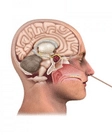
Skull Base Surgery in India
Skull base surgery removes any benign or cancerous tumours present in the under side of the brain called as the skull base
What is Skull Base Surgery?
Skull base surgery refers to a group of operations to remove the brain or nerve tumors that occur at the bottom of the brain.
Your brain rests in a bony chamber called the ‘cranium’ or the ‘skull’. It protects the brain from injuries. On the top of the skull are large and smooth bones that provide a round appearance to the head.
At the base of the skull are bones that separate the skull from organs in the face. There are three large depressions in the skull at its base. These depressions or fossae act as seats for the brain. Three fossae in the skull are the anterior, middle, and posterior cranial fossae.
There are several openings in these fossae for the spinal cord and cranial nerves from the brain to pass down. Similarly, there are large canals for the arteries and veins that supply and drain blood from the brain to pass through.
Skull base tumors occur at the base of the brain as it meets the skull base. During a minimally invasive skull base surgery, the surgeon makes use of the natural openings in the cavities of the skull base like the nasal, orbital, oral cavities. Some skull base surgeries use an artificial opening in the skull bone through a craniotomy.
Skull base surgeries help to remove cancerous and non-cancerous tumors at the base of the brain. It also helps in treating bony tumors at the skull base as well as at the top vertebrae.
Skull base surgeries – when to do
Skull base surgeries can help in treating the following conditions.
- Cysts in the base of the brains like arachnoid, dermoid cysts, etc
- Infections like osteomyelitis of the skull base
- Acoustic neuroma, a tumor of the vestibulocochlear nerve that supplies the ear
- Tumors of and close to the pituitary gland like pituitary adenomas and craniopharyngiomas
- Benign tumors of the meninges like meningiomas
- Skull base chordomas which are malignant cancers
Apart from this, skull base surgeries can also correct problems with the nerves and blood vessels. These include
- Trigeminal neuralgia- It is a painful condition that affects the trigeminal nerve that carries sensations from the face to the brain
- Hemifacial spasm- A condition where there is sporadic twitching of the muscles on one side of the face. It occurs due to pressure on the facial nerve due to a tumor or aneurysm.
- Cerebral aneurysms in the base of the brain- These are enlargement in the cerebral arteries in some areas.
Injuries to the head and face can also damage the bones in the base of the skull. Fractures of the base of the skull will also need surgery for correction.
Craniosynostosis, a birth defect that causes an abnormal skull shape, also needs a skull base surgery. In this condition, the sutures or fibrous joints that connect the skull bones close prematurely. It causes a lot of pressure in the brain as it develops.
What are the symptoms due to problems in the skull base?
If you have problems in the base of the brain or the skull, some of the common symptoms you will have include
- Pain in the face- You may have pain in some areas of the face. The areas of pain will depend on the location and type of problem you have.
- Headaches- Tumors, as well as other problems, will give you recurrent headaches.
- Dizziness- Compression on some nerves or blood vessels close the skull base can make you feel dizzy. Loss of balance will occur if the problem is severe.
- Numbness or weakness of the face- These occur due to problems with cranial nerves as they exit the skull base. Compression on the sensory nerves causes numbness while on the motor nerves, it causes weakness.
- Problems with the vision- It occurs due to effects on the optic nerve
- Hearing problems- Tumors like acoustic neuromas can cause hearing loss and a ringing of the ears or tinnitus
All these symptoms can occur due to other problems as well. For an accurate diagnosis, you will need a few tests to confirm the problem.
Diagnosis of problems in the skull base
If you have any symptoms that point to growth or abnormality in the skull base, you will have a thorough physical examination
Physical exam- During this, your doctor will thoroughly analyze your symptoms. You will have a few clinical tests to assess the nerves that may be responsible for the symptoms.
If the physical exam points to a skull base abnormality, you will have a few other tests.
Imaging tests- You will have an MRI and CT scan of the base of the skull. These scans will show any problems at the base of the brain. Problems with nerves, blood vessels, and bones at the base of the skull will also be very clear in these scans.
If your doctor suspects a tumor, you will have a contrast MRI scan with spectroscopy and tractography. It helps to assess the type and extent of tumors.
Biopsy- A biopsy is a test to confirm whether a tumor is cancerous or not. Infections of the skull bones will also need a biopsy to confirm the nature of the infection.
Types of skull base surgery
Skull base surgeries are mainly of two types. They are
Minimally invasive endoscopic surgery
In this surgery, the surgeon reaches the skull base through natural openings of the nasal cavity, sinuses, etc. The surgeon may also gain access by creating small openings in the bone above the eye or behind the ear.
Patients will have general anesthesia for the procedure. The surgeon will insert an endoscope, which is a flexible tube-like instrument with a light and camera at the tip. It helps the surgeon to see the area of surgery on a large screen. The surgeon will then insert small surgical instruments through the endoscope to do the surgery.
The main advantage is that risks and complications are less in number in comparison to open surgery. Recovery is also faster with this type of surgery.
Open surgery
In some skull base problems, it is difficult to reach the involved area through minimally invasive surgery. In such cases, the surgeon will go for open surgery.
A patient for open surgery will have general anesthesia. The surgeon will then remove a part of the skull close to the problem area through a craniotomy. After the surgery, the surgeon will replace the bone part in its original position and secure it with wires, screws, or plates.
Recovery
Your recovery will depend on the type of surgery. If you have endoscopic surgery, your recovery will take two to three weeks. Recovery from an open surgery will need a few weeks more.
During the recovery period, you will have to visit the hospital at regular intervals. Your surgeon will assess your progress as well as do a few tests to ensure that everything is fine.
Most of the skull base surgeries are safe. But like other surgeries, there are a few risks and complications as well.
Risks and complications
Leakage of CSF into the nose is the most important risk. CSF is a fluid that lies in between the layers of the meninges. An accidental tear of the meninges during surgery can cause it to leak into the nose. Repair surgery is necessary to correct this problem.
Other common risks occur due to problems with cranial nerves during surgery. Most of these are temporary and gets better within a short time. These include a loss of smell, taste, hearing, etc. There will also be numbness, weakness, or pain in some areas of the face as well
Top Hospitals for Skull Base Surgery
We partner with India's most respected accredited hospitals.




Frequently Asked Questions
Skull base tumours are tumors of the brain, nerves, blood vessels, etc in the base of the brain. Most of the skull base tumors are benign or nancancerous, while a few are malignant. Some of the common skull base tumors are Vestibular schwannoma,Meningioma, Chondrosarcoma, Chondroma, Pituitary adenoma, Craniopharyngioma, etc
Majority of skull base tumors are non-cancerous. But still these can cause disturbing symptoms and complications due to the pressure that these exert in the brain. You will need a surgery if a tumour increases in size rapidly and causes severe symptoms. There are two types of skull base surgeries. In an open surgery the surgeon will make a hole in the skull to remove the tumor. In a minimally invasive surgery, the surgeon will remove the tumour through any of the natural openings in the skull
While minimally invasive surgeries are generally more safe, some skull base tumors will need an open surgery. During an open surgery , the surgeon will first perform a craniotomy . Craniotomy is a surgery where the surgeon will remove a part of the skull to reach the brain. After the tumor removal surgery, the surgeon wil place this part at its position and secure it
In a minimally invasive skull base surgery, the surgeon will reach the skull base tumor through a natural opening in the skull. The most common choices are through the nasal and sinus cavities. The main advantage of this type of surgery is a lower risk of damage to other areas of the brain. The recovery is also faster in comparison with an open surgery
The average cost of skull base surgery in India will be in the range of 8,000 USD to 8,500 USD. The duration of hospital stay will be around ten to twelve days depending on your recovery. Overseas patients will have to be in India for about three weeks
Get a Free Quote
We respond within 2 working hours.
Request Received!
A coordinator will contact you within 2 working hours.